About Mandala Room
Mandala Room was created as a space for people who sense that life can be deeper, more meaningful, and more creative than the rhythm they are currently living. It is built for those who want to reconnect with their inner voice, cultivate self-trust, and walk an authentic path that feels alive and personally true.
After many years of searching for meaning, I realised that my deepest joy comes from creating, from the quiet magic of watching ideas transform into shape, color, form, and sensation. Creativity is the moment when life flows through you. It is where energy becomes matter.
I am no longer interested in being merely an observer of life. I want to be its creator.
And this journey is so rich, so transformative, that I wanted to share it with others who also long to live in this way -curiously, originally, creatively, guided by their own inner wisdom.
Mandala Room was born from this desire: to offer a gentle, structured, and deeply meaningful path back to oneself through creative practice.
The first workbooks focus on stress reduction and overthinking, because these are often the very first layers standing between us and our intuitive clarity. When the mind softens and the nervous system calms, the inner voice becomes audible again.
Mandala Room is not a psychotherapy practice. While the method is grounded in psychology, mindfulness research, and art therapy principles, it is designed for self-reflection, emotional awareness, and creative exploration, not for the treatment of mental health disorders.
If someone is experiencing deep emotional pain, trauma, or severe psychological difficulties, I strongly encourage them to seek support from qualified professionals.
Mandala Room is a space for self-discovery, creativity, and gentle inner alignment.
A Multidisciplinary Foundation
The Mandala Room Method is built on a carefully crafted integration of established disciplines that support clarity, emotional regulation, and creativity.
Mindfulness-Based Foundations
The practice draws on the evidence-based principles of Mindfulness-Based Stress Reduction (MBSR), developed by Jon Kabat-Zinn (1990). Research consistently shows that mindfulness enhances emotional regulation, reduces stress, and builds resilience (Kabat-Zinn, 2003; Baer, 2006).
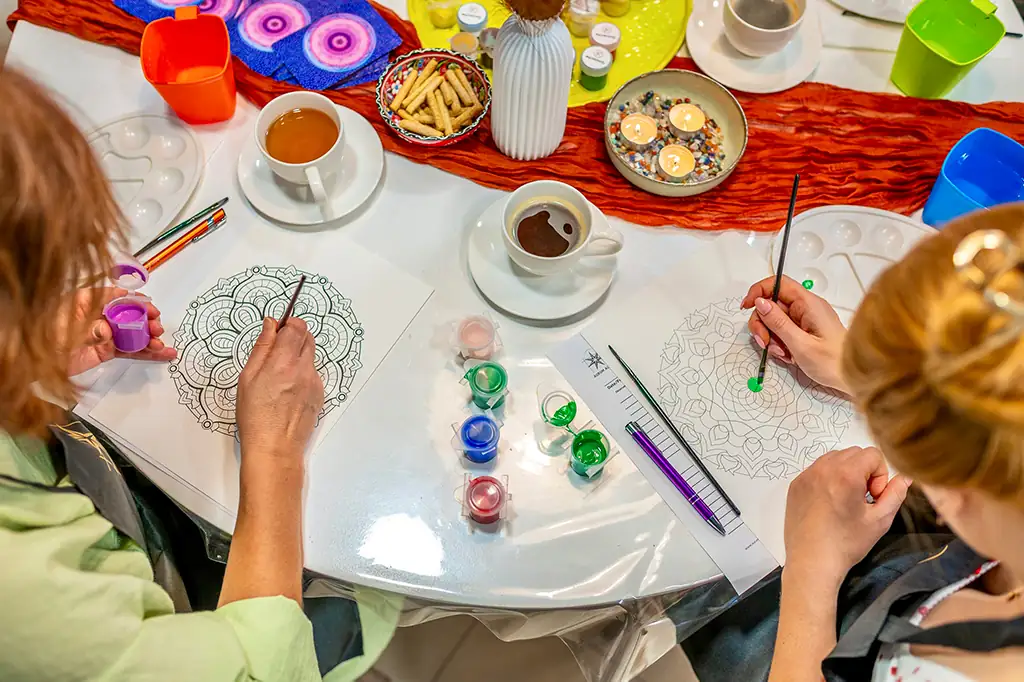
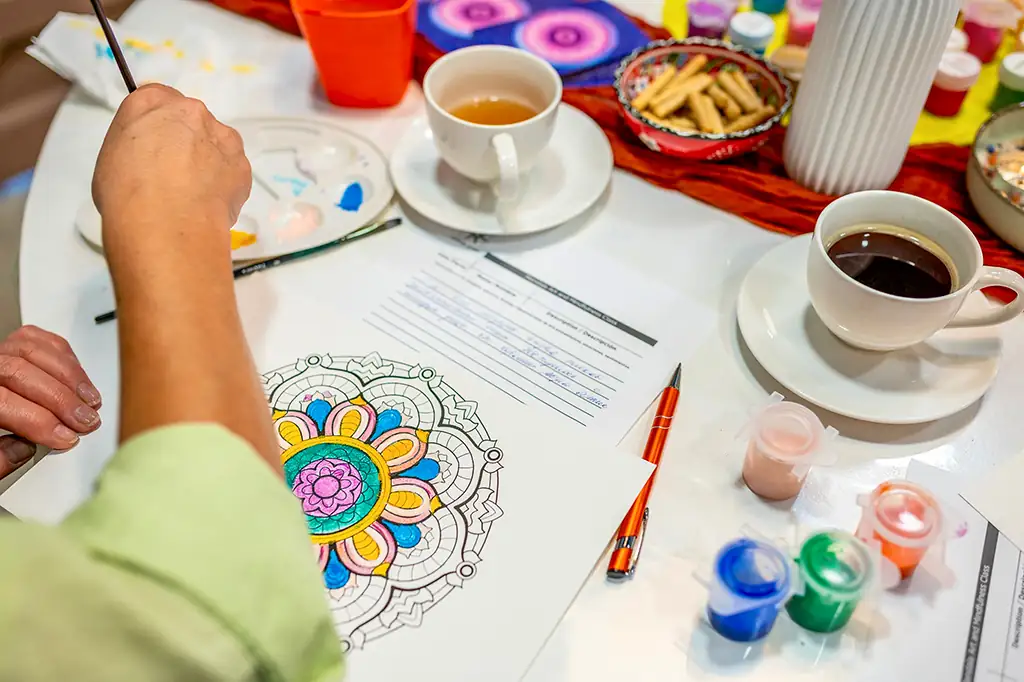
Coloring symmetrical, repetitive patterns naturally induces a meditative focus, offering an accessible entry point into presence-even for those who struggle with traditional meditation.
Art Therapy and the Mandala Symbol
Mandalas have long been used in art therapy as structured forms that safely hold emotional exploration. As Cathy Malchiodi (2007) notes, creative engagement within a defined structure provides “a safe container for expression.”
Carl Jung viewed the mandala as a symbolic representation of the psyche’s wholeness-“the psychological expression of the totality of the self.”
In Mandala Room, mandalas serve not as decorative illustrations but as symbolic maps of inner experience, supporting integration and self-understanding.
Self-Coaching and Reflective Practice
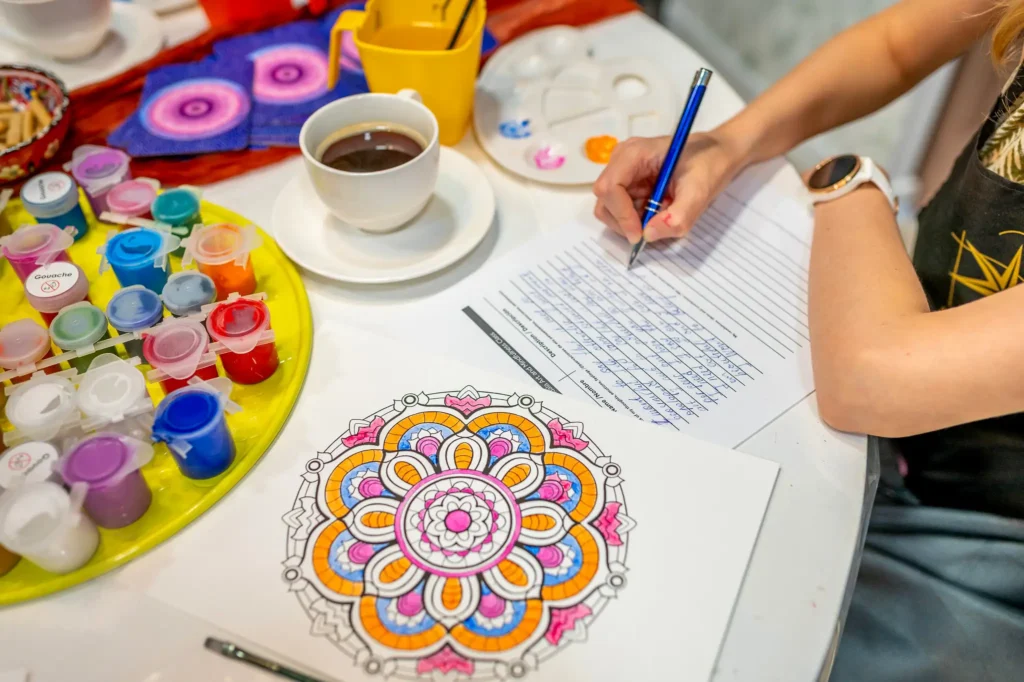
Each mandala is accompanied by reflective coaching-style prompts, inspired by the work of Whitmore (2009) and Grant (2014). These questions help individuals:
- identify internal patterns
- clarify personal intentions
- cultivate deeper inner dialogue
- discover answers that arise from within, not from external expectations
This turns the creative process into an internal coaching conversation, guiding gentle yet meaningful personal development.
Symbolic and Archetypal Dimensions
Drawing on the ideas of Jung, Joseph Campbell, and James Hillman, Mandala Room integrates symbolic and archetypal language that speaks directly to the subconscious.
Symbols are not interpreted prescriptively; instead, they are offered as resonant forms that invite personal meaning-making.
This ensures that each practice remains deeply individual-opening pathways toward insight, self-recognition, and existential clarity.
What This Integration Offers
Together, these elements create a practice that is both accessible and profound:
Mindful regulation
A pathway to grounding, soothing the nervous system, and softening stress responses.
Creative expression
A safe and structured way to transform emotions into symbolic form.
Personal clarity
Insights that emerge from within, guided by intentional reflection.
Symbolic depth
A connection with archetypal imagery that speaks beyond words.
A return to inner voice
The rediscovery of one’s intuitive wisdom – subtle, honest, and uniquely personal.
Through this synthesis, Mandala Room transforms the simple act of coloring into a non-formal, research-informed self-development practice, a creative and gentle pathway to inner coherence.
Mandala Room Mission
Mandala Room exists to help you:
- reconnect with your inner voice
- trust your intuition
- rediscover your creative nature
- live with greater clarity, depth, and authenticity
It is a place where creative exploration meets psychological wisdom.
A place for people who want to walk an interesting, original, and meaningful path, their own path.